Friday, 19 March 2010

Proposal! Personal Project time

I propose to make a mini documentary about the lives of homeless people on the streets of Bath. I would follow the stories of one or two people, delving below the surface to show the real lives and emotions of people that most often go ignored or are scorned simply because of their circumstances. I would like to find a story of the reasons why a person can end up destitute and on the streets struggling to survive on a day-to-day basis, how they are treated and what they go through every day. The purpose of this would be to change perspectives on how we treat or view homeless people, contrasting vox pops of middle-class people saying how they view homeless people with the reality of how it is to be living on the streets.


I would also like to perhaps find another person with completely different reasons of why they are homeless and contrast their lives - one, a stereotypical 'bum' that has no reason for being homeless other than being a junkie and too lazy to get up and find a job, and the other one that has it together, is intelligent and can hold a conversation yet has had hard circumstances that have resulted in him being unable to live any other way. I want to do this to show that, although there are homeless people who live that way almost because are simply too lazy or addicted to drugs or alcohol to get a job and a place to live, there are also those who have stories and reasons that break the stereotypes of how we often view them, challenging the 'scum of society' stigma.
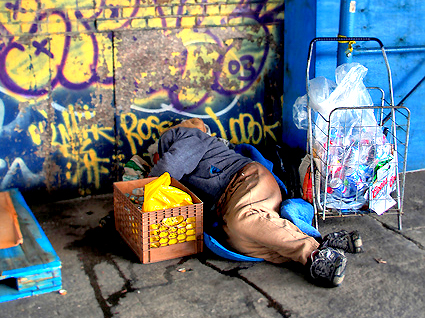


The purpose of this would be to create a challenging, thought-provoking piece that would follow the lives of two homeless people in order to show their emotions and feelings, focusing mainly on their personalities in order to show them as a real, normal person that perhaps has had harder circumstances than most. I would like this piece to show humour, reality and views on life that could challenge the norms of how we see the homeless.


The piece would be aimed at young, upper-to-middle-class adults that live in an urban environment and would come into contact with these realities every day. The tone would need to informative, yet I would like it to be more informal and down-to-earth, showing real life, that this is a reality that needs to be looked at differently. I would also try to make sure that the tone is not condescending or patronising in any way and not too heavy or depressing, but is frank, challenging and uplifting, carrying an ultimate message of hope that we can play a part in changing lives of those around us.


Friday, 5 March 2010

Cookery team filming day - 4 hours for a 3 minute instructional video


For this assignment, we were put into groups to make a 3 minute instructional video of how to do student-friendly cooking that is healthy, easy and cheap. Our group (Chloe, Mike, Tom and me) decided to do a healthy stir fry with peanut butter and sweet chilli sauce and lots of vegetables. We decided this because it contains 4 of the 5 a day, it's easy and cheap and we had the ingredients and appliances needed. We filmed in Mike's kitchen as he lives on campus and has a stellar wok from Ikea that worked perfectly for it.


Pre-Production

When we first arrived at 2:00 we started setting up Mike's kitchen for filming - cleaning, clearing space for the actual cooking, setting up lighting (we had to put up makeshift curtains to block the bright sunlight coming in from the side, as can be seen in the photo above) and making a living food sculpture to film the first shot of the ingredients, as shown.


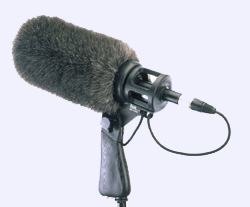
We then had to set up the equipment, which included a Sony Z1, a Manfrotto 503HDV tripod and a Rycote pistol grip and gun mike.


After all the equipment was set up, we set up the white balance and focus, and then got the first shot of the ingredients over which we want to superimpose text saying how much of each ingredient is needed. We thought this would be the easiest to go with a voice over, which is how we want to present it. We then started the cooking, showing the chopping of the vegetables (with me and Chloe tag-teaming it) with the rest of our beautiful food sculpture in the background to make it a bit more interesting and less antiseptic-looking than just a plain white wall. While we're going to get the sound of the voice over later separately, we wanted to get the sound effects of the chopping and cooking to put in to make it realistic and to use these to support the visual.


So, after some chopping mishaps and falling veg and chicken but still getting a successful take of what we wanted, we went on to the stir-frying part of it. We fried the onions, making sure to get the sizzling sound effect, then added the chicken and vegetables. We were able to get some good birds-eye view shots by raising the tripod to its highest setting, as shown in the photo below!

After getting a wide range of shots of each step of the cooking, such as close ups, pans, wide shots, etc, we finished the cooking and all tried the final product, which turned out not too bad, if we say so ourselves! we were definitely all made hungry enough for it by missing lunch and waiting four hours longer than we thought we'd need to, but it was worth the wait.


A few things we would have done differently in retrospect might have been:

- Be more prepared, maybe make a storyboard and list of everything we would need. At first we did a shot of the cooking utensils we thought we'd need, but ended up using much more than we thought we would. This made the day longer than it needed to be because instead of being able to the shot of all the utensils before we started cooking like we wanted to do, we needed to wait for the food to be finished, eat the food, do all the washing up, dry everything and set everything up a second time with the added utensils we had forgotten about.

- Started earlier in the week. Trying to sort out all our schedules to figure out a time for us all to meet proved harder than we thought it would be, and it made us go behind schedule with editing. We also had problems logging and capturing it, which if we had given ourselves more time we might have been able to sort out before the lesson.

Overall though, we all enjoyed this project and it provided important experience in the technical aspects of filming, in recording sound using a boom microphone and knowing how much to prepare for pre-production. We gained knowledge and experience and we'll be beginning the editing process next week.

Tuesday, 9 February 2010

'OMG!' Short filming exercise and collaboration...and it all comes down to the 180 degree golden rule of filming.

In preparation of our short film project which we will be directing, producing, editing and perhaps even starring in ourselves for some of the groups, we did a mini filming exercise last Tuesday in our groups. Ant, James and I went out to film around campus using a script written by Mike Johnston himself about someone who receives a phone call that brings mysterious bad news. We did this in order to get used to filming in a way that doesn't break the cardinal rule of filming: the 180 degree rule.
Each of the groups were given a different direction to keep true to, ours was to be shot going from left to right, making sure that we never broke the 180 degree rule. Here is our finished product (which was heavily edited by James at the end to make me sound like I was making some sort of animal noise!)


After this, Mike had us do a collaboration with another group that was doing the opposite direction to us to show how the continuity of direction would be broken if we did ever pass the 180 degree line. We linked up with Ed, Mike and Kirsty to do our joint collaboration, shown below:


This is good to know since it's the small details like this that make films work. We don't realise how much needs to be taken into consideration so that the finished piece will make sense to the audience, so this exercise was good for hammering the golden 180 degree rule into us for the future. It was also loads of fun filming it and gave us some directing, filming, producing, editing and acting experience.

Here is the finished product, with our own twist on the ending...enjoy!

OH MY GOD! from James Harris on Vimeo.

'So It Goes': The Pitch! at Paintworks Studios in Bristol.

On Tuesday we all went to Paintworks Studios in Bristol, where much of the 3rd year work will take place, to pitch our ideas for our short film projects to the director of Paintworks and Mike in a semi-formal setting (at least more formal than we're used to!). We created a PowerPoint presentation to present our proposal, treatment and influences of our piece, shown below:


This was a good experience for us since it prepares us for what we might do in future jobs if we go into this sort of work, pitching ideas formally and preparing every aspect of the story. Some pointers that we were given were that we need to definitely decide on who will be the main character of the story; we need to make sure it's doable in the 5 - 7 minute timeframe and not complicate it too much; and our presentation should have been more legible and appropriate for presenting - less words, more impressions. All these things are good to know for the future and will definitely be taken into account for the next time.

Friday, 5 February 2010

Short Film Project 'So It Goes': the ideas and the process


Our next group project is making a short film. We brainstormed our ideas and put ourselves into groups depending on which idea we wanted to use and after some deliberation I joined with James and Ant. We decided to do a short psychological thriller piece entitled So It Goes, following the last few days of a schizophrenic man's life through his own journal entries, found by a mysterious woman who seems to be obsessed with finding out about this man for reasons we only find out at the end.

It took us a while to get all the details of the plot and storyline down, since we started with a much simpler idea but have since modified it to try to make it more original and avoid the trap of predictability. We decided after speaking with Mike that if we only made it centred on the man, it would follow a storyline that's been done many times over. By introducing the mysterious woman though and making the film mainly about her and why she's trying to find out about this man's life, we hope to put a twist on the plot and make an original, interesting and thought-provoking short film (full details of plot, proposal and treatment can be found in the PowerPoint presentation in the blog about our pitch at PaintWorks Studios).

When we spoke with Mike the first time about our idea, he suggested we go by an acronym used in script writing: CDOG. He said that we need four elements to make a good storyline: we need a Character, there needs to be a Desire, there then needs to be an Obstacle to them getting that desire and finally there needs to be a resolution, reaching the Goal. This helped us in forming our storyline below:

Character - We decided to put a twist on the story and instead of the man who is narrating the piece be the main character, make it the mysterious woman seen in the beginning of the film.

Desire - This character's main desire, that we only realise at the end, is to try to find out what is wrong with her mentally by following the footsteps of the man she suspects has the same mental condition.

Obstacle - The obstacle will be that as soon as she realises that there is someone else that is suffering from the same symptoms that could be able to help her, she starts following him attempting to find a way to approach him. However, she loses him in the city and finds out later about his death by reading about it in a newspaper. This shatters her hopes of finding out what it could have been they both shared in common, but she is determined to still find out all she can - hence the obsessive collecting of anything to do with him we see scattered across her desk in the title sequence of the film.

Goal - After stumbling across his diary of his last few days before his death, she finally realises after reading the last page that he had a split personality - and leaves with a newfound hope realising that this is the condition she had as well, knowing that now she can finally get help for it now that the mystery is put to rest.

We would like to shoot this film in a style influenced largely by a music video shot to a song by the band The National, called Daughters of the SoHo Riots:


We would like to film the main part of the film which takes place in the past through the man's narration in black and white as shown above, using specific lighting to highlight certain areas and black out others. We want to emphasise the contrast of his different personalities by using high contrast in the filming and make use of silhouette lighting as much as possible.

Timeline -

Proposal and treatment for group video project 22/01/10
Pitch for group video project 02/02/10 at Paintworks
Complete peer assessment of group projects 23/04/10
Complete group projects 04/05/10

Tuesday, 26 January 2010

Celtx Storyboard: How to get from sheep to a rug, the complete DIY process


For this assignment, we had to create a storyboard for an instructional video using software program Celtx, which allows you to sketch out the positions of cameras and equipment for each shot. After trying to decide what to do for it, I got inspired when I was away for the weekend in Devon and decided to do a step by step storyboard of how to get from a sheep to a household rug, showing the complete DIY process. My fiance's mother is a weaving extraordinaire and does this on a regular basis, so happily enough she agreed to model each step for the photos.

Below is a Google Docs presentation of the finished CeltX storyboard presentation.


I found that there are many advantages to using CeltX, as it provides a way of being able to visualise and lay out exactly how the process of filming will take place. It makes planning much easier and the process itself is simplified, since the shots are already completely laid out and all that's left to do is follow the story board on the day of actual shooting.

Thursday, 17 December 2009

Final Cut Pro basics 'cheat sheet'


As we're doing most of our work so far on Final Cut Pro, we've created 'cheat sheet' PowerPoint presentations outlining all the basics of editing using Final Cut. I did mine using screen shots to illustrate visually how to do each thing and I'm sure I'll be using this presentation to refer back to in future edits. Click here to see the presentation on Google Docs.